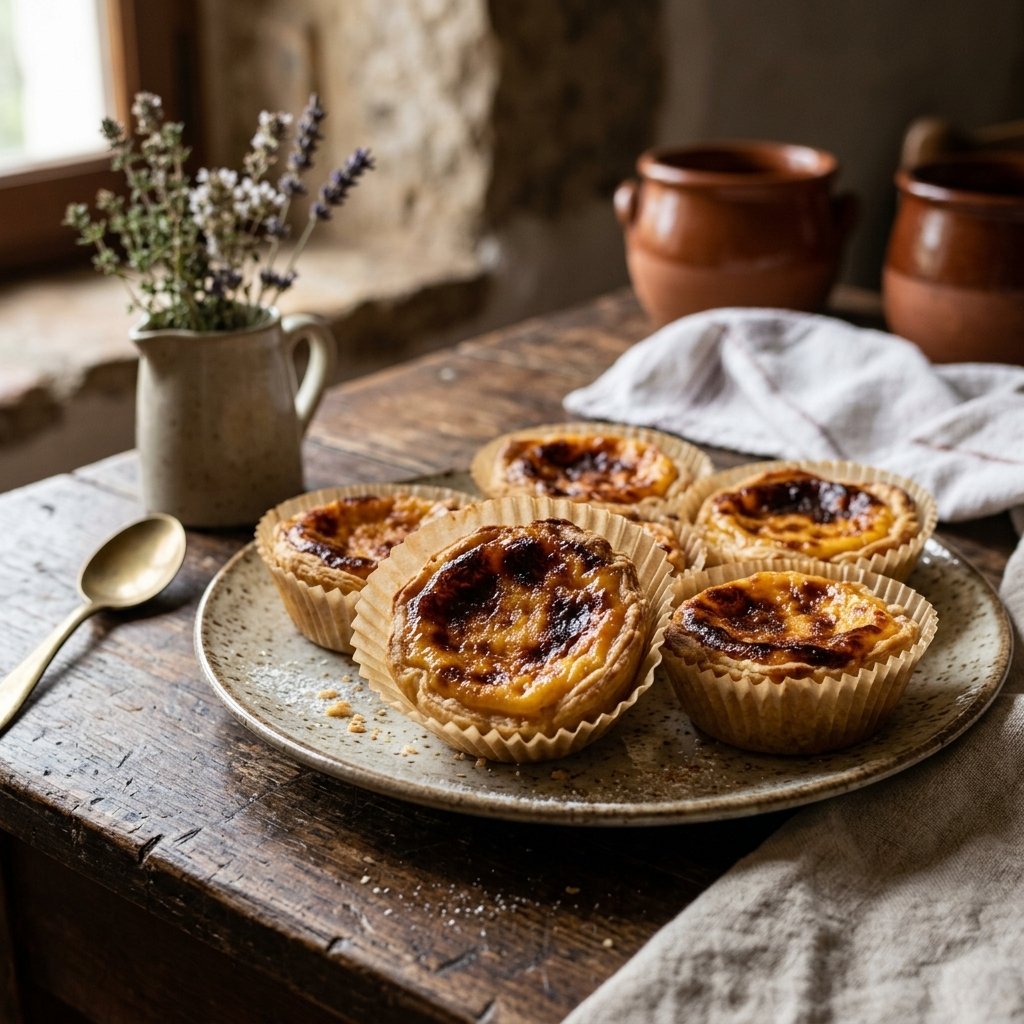
Queijadas de Évora (Alentejo Sheep's Cheese Tarts)
- Prep
- 20 min
- Total
- 45 min
- pieces
- 12
- Calories
- 235 kcal
Queijadas de Évora are one of the best-known convent sweets of the Alentejo. They were born in the Convent of Santa Clara in Évora and stand out for their very thin lard pastry around a moist filling of fresh sheep’s cheese (or requeijão), egg yolks and sugar.
Recipe
Queijadas de Évora
A small cup of very thin pastry filled with sheep's cheese and egg yolks, with a scorched top.
Ingredients
Pastry
Filling
Method
For the pastry
- 1Rub the flour with the lard and butter. Add warm salted water a little at a time, kneading hard until you have an elastic, smooth dough that doesn't stick to your hands.
- 2Shape into a ball, cover with a cloth and let it rest for 1 hour.
For the filling and baking
- 3Push the cheese through a fine sieve (or mash it very well with a fork).
- 4In a bowl, mix the cheese with the sugar. Add the strained yolks and the melted butter. Stir well without beating too much, so you don't add air.
- 5Roll out the pastry on a floured surface until almost see-through.
- 6Line small queijada tins with circles of this very thin pastry.
- 7Fill the tins with the filling (about 3/4 full).
- 8Bake in a very hot oven (220 to 250 °C) for 10 to 15 minutes, so the tops scorch (with the characteristic dark crust) while the inside stays moist.
- 9Turn them out carefully once cold.
Tips
The traditional recipe uses fresh sheep’s cheese from the region and homemade pastry. Many people now use cow’s milk requeijão and store-bought shortcrust to save time, but for anyone who knows the original, homemade lard pastry makes all the difference.
The dark, scorched top is part of the queijada: a very hot oven browns it fast while the inside stays creamy.
Because they contain cheese and yolks, keep them in a closed box in the fridge. They last 3 to 4 days and are lovely cold on a hot summer afternoon.