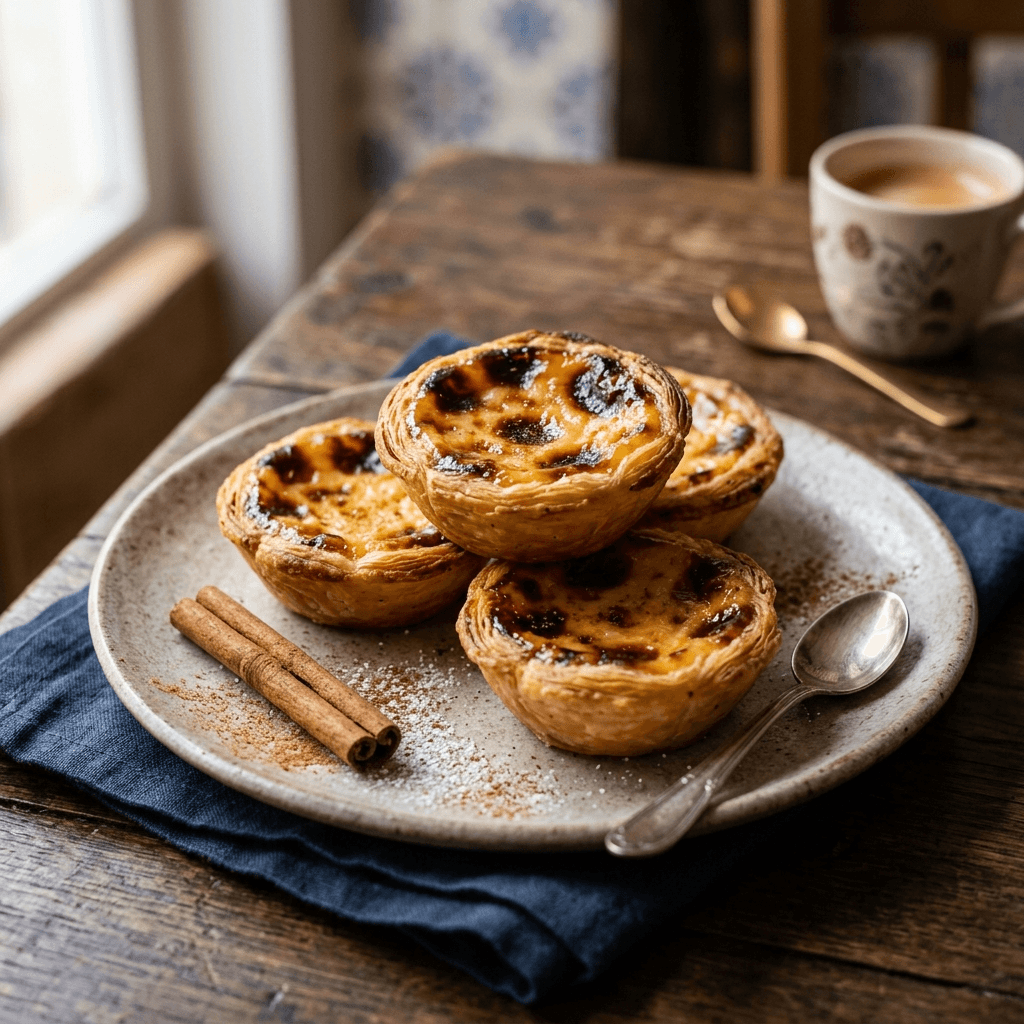
Pastéis de Nata (Portuguese Custard Tarts)
- Prep
- 30 min
- Total
- 45 min
- tarts
- 12
Pastéis de nata are Portugal’s most famous pastry: a crisp puff pastry shell filled with a custard of milk, sugar and egg yolks, baked very hot until the top gets its typical dark spots. This version uses store-bought puff pastry and makes 12.
They were first made at the Jerónimos Monastery in Belém, where the monks used the egg yolks left over from the whites used to starch clothes. When the religious orders were dissolved in 1834, the recipe was sold to a sugar refinery next to the monastery, which opened the Pastéis de Belém bakery in 1837. That recipe is still secret, but every pastelaria in the country makes its own.
Tips for bakery-style tarts
Bakeries bake them at more than 300 °C (575 °F). At home, use the highest setting your oven has, ideally 250 to 280 °C (475 to 525 °F), and preheat it well.
Wet your thumbs when lining the tins so the pastry doesn’t stick, and leave the rim a little above the tin.
Don’t overfill them: leave a millimeter or two at the top, because the custard puffs up in the oven.
They’re at their best on the day they’re made, still warm, dusted with cinnamon and powdered sugar.
Recipe
Pastéis de Nata
Portugal's most famous pastry: crisp puff pastry filled with a smooth custard flavored with cinnamon and lemon, baked very hot until it caramelizes on top. Best eaten warm.
Ingredients
Method
- 1Unroll the puff pastry and, starting from a short side, roll it up again into a very tight log. Cut the log into rounds about 1.5 to 2 cm thick.
- 2Butter 12 pastel de nata tins. Put a round of pastry in the middle of each one.
- 3With your thumbs lightly dipped in water, press the center of the pastry down against the bottom and push it up the sides of the tin, leaving a rim slightly higher than the metal edge. Set aside.
- 4In a saucepan, combine the water, sugar and cinnamon stick. Bring to a boil without stirring and let it boil for exactly 3 minutes once it starts bubbling, to a light syrup. Take it off the heat and discard the cinnamon stick.
- 5In a bowl, dissolve the flour in a little of the cold milk (taken from the 500 ml) until there are no lumps.
- 6Heat the rest of the milk with the lemon peel. When it boils, remove the peel and pour the hot milk in a thin stream over the flour mixture, whisking all the time.
- 7Gradually add the hot sugar syrup to this mixture, whisking constantly. Let it cool for about 10 minutes.
- 8Strain the custard through a fine sieve so it's smooth. Add the beaten egg yolks (the custard must not be boiling, or the yolks will cook) and mix very well.
- 9Fill the pastry-lined tins with the custard, leaving a couple of millimeters free at the top.
- 10Bake on the middle shelf with the oven as hot as it goes, 250 °C (475 °F) to 280 °C (525 °F), for about 12 to 15 minutes, until the custard puffs up and gets its dark spots and the pastry is golden.
- 11Take them out, let them cool a little and unmold. Serve warm, dusted with cinnamon.
No dark spots?
The oven isn’t hot enough. Preheat it well on the highest setting and bake on the middle shelf. If your oven has a grill, you can switch it on for the last few minutes, keeping an eye on them.
Making ahead and storing
You can make the custard the day before: strain it, keep it in a closed container in the fridge and stir it well before filling the tins. The baked tarts keep at room temperature in a closed container until the next day. Warm them for 3 to 5 minutes in a very hot oven to crisp them up again.