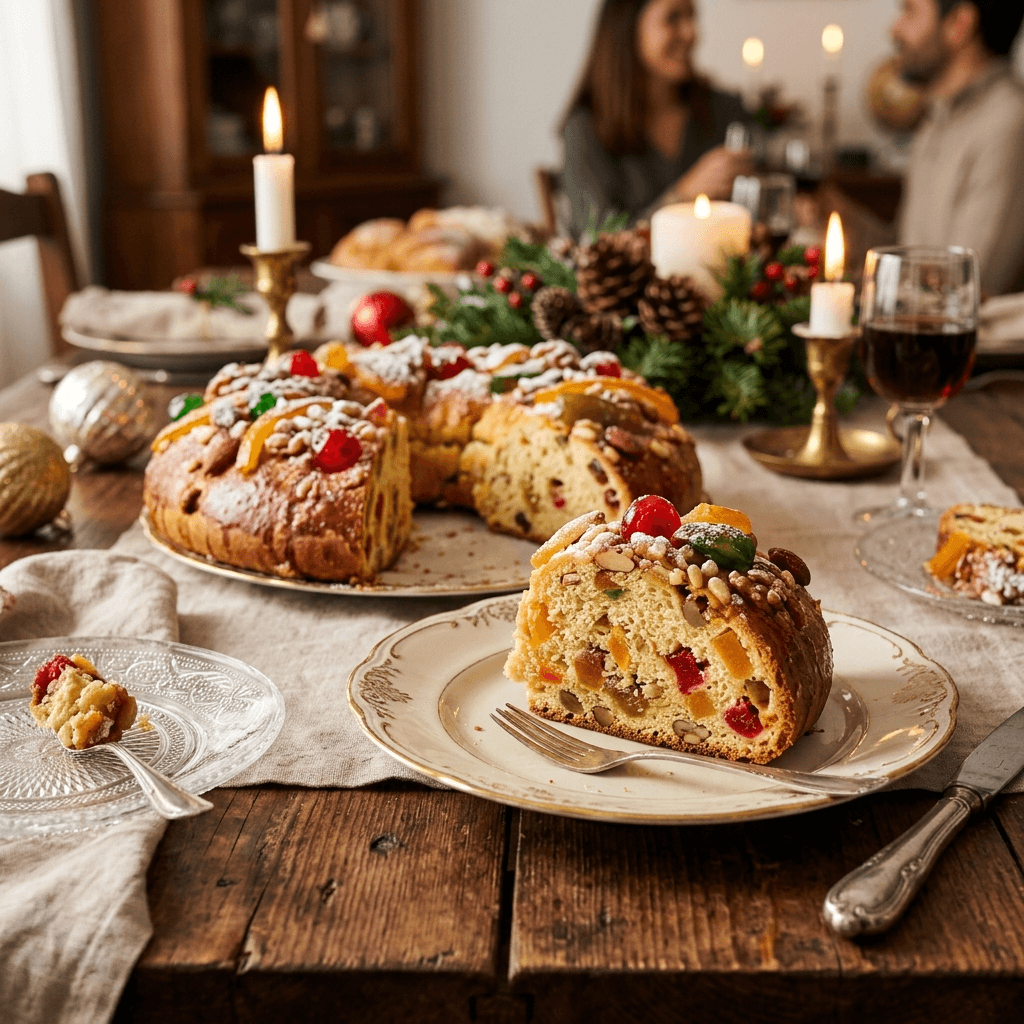
Bolo-Rei (Portuguese King Cake)
- Prep
- 3 h
- Total
- 3 h 40 min
- slices
- 10
- Difficulty
- Medium
Bolo-rei is the Portuguese Christmas cake: a soft yeasted dough scented with orange and lemon zest and port, filled with nuts and crowned with candied fruit. It’s eaten from December until Epiphany, the Dia de Reis on January 6, which gives it its name (“king cake”). This recipe makes one large cake.
It arrived in Portugal in the 19th century, inspired by the French gâteau des rois, and was made popular in Lisbon by the Confeitaria Nacional, on Praça da Figueira. The crown shape and the candied fruit, like jewels, recall the Three Kings. For decades the cake hid a dried broad bean and a small prize: whoever found the bean paid for next year’s cake. The prize was dropped for food safety reasons, and the bean is getting rare too.
If you don’t like candied fruit, look for bolo-rainha (“queen cake”), made with nuts only.
Recipe
Bolo-Rei
The Portuguese Christmas cake: a soft, fragrant yeasted dough with candied fruit and nuts, scented with port and citrus zest. A Christmas tradition that brings the generations together at the table.
Ingredients
Dough
Filling and decoration
Method
Getting ready
- 1At least 1 hour ahead, or the day before, soak the chopped candied fruit in the port.
- 2Dissolve the yeast in the warm milk with a tablespoon of the sugar. Add 2 to 3 tablespoons of the flour, mix and leave in a warm place for 15 to 20 minutes, until foamy.
Dough
- 3In a large bowl, or in a stand mixer with the dough hook, combine the rest of the flour, the salt, the rest of the sugar and the lemon and orange zest.
- 4Make a well in the center and add the butter, 2 lightly beaten eggs, the port drained from the fruit and the yeast mixture.
- 5Knead for 10 to 15 minutes, until the dough is smooth and elastic and comes away from the sides of the bowl. It should be soft and a little sticky.
- 6Spread the dough out on the counter, add the drained fruit and the nuts and knead just enough to spread them through.
- 7Shape it into a ball, put it back in the bowl, cover with a cloth and leave it to rise in a warm, draft-free place for 1 hour 30 minutes to 2 hours, until doubled.
Shaping and baking
- 8Turn the dough out onto a floured counter, flatten it into a round and open a wide hole in the center with your fingers. Put it on a baking tray lined with parchment paper.
- 9Let it rise again for 40 to 50 minutes. Heat the oven to 180 °C (350 °F).
- 10Brush the cake with the remaining beaten egg and decorate the top with the whole candied fruit and a few nuts. Moisten the powdered sugar with a few drops of water and dot it over the top in little heaps.
- 11Bake for 35 to 40 minutes. If the top starts to darken early, cover it with foil halfway through.
- 12As soon as it comes out of the oven, brush it with warmed apricot jam to make it shine. Let it cool on a rack.
Tips for a soft bolo-rei
Give the dough time. With this much butter, egg and sugar, it rises more slowly than bread. Let it rise somewhere warm and draft-free, such as inside the oven, switched off, with only the light on.
Keep the hole in the middle open. Make it wide when you shape the crown, because it closes up a lot during the second rise and in the oven. A small greased bowl, upside down in the center, helps.
Protect the top. The fruit and sugar burn quickly, so cover the cake with foil if it browns too early.
A stand mixer with the dough hook saves a lot of effort: this dough is sticky and tiring to knead by hand.