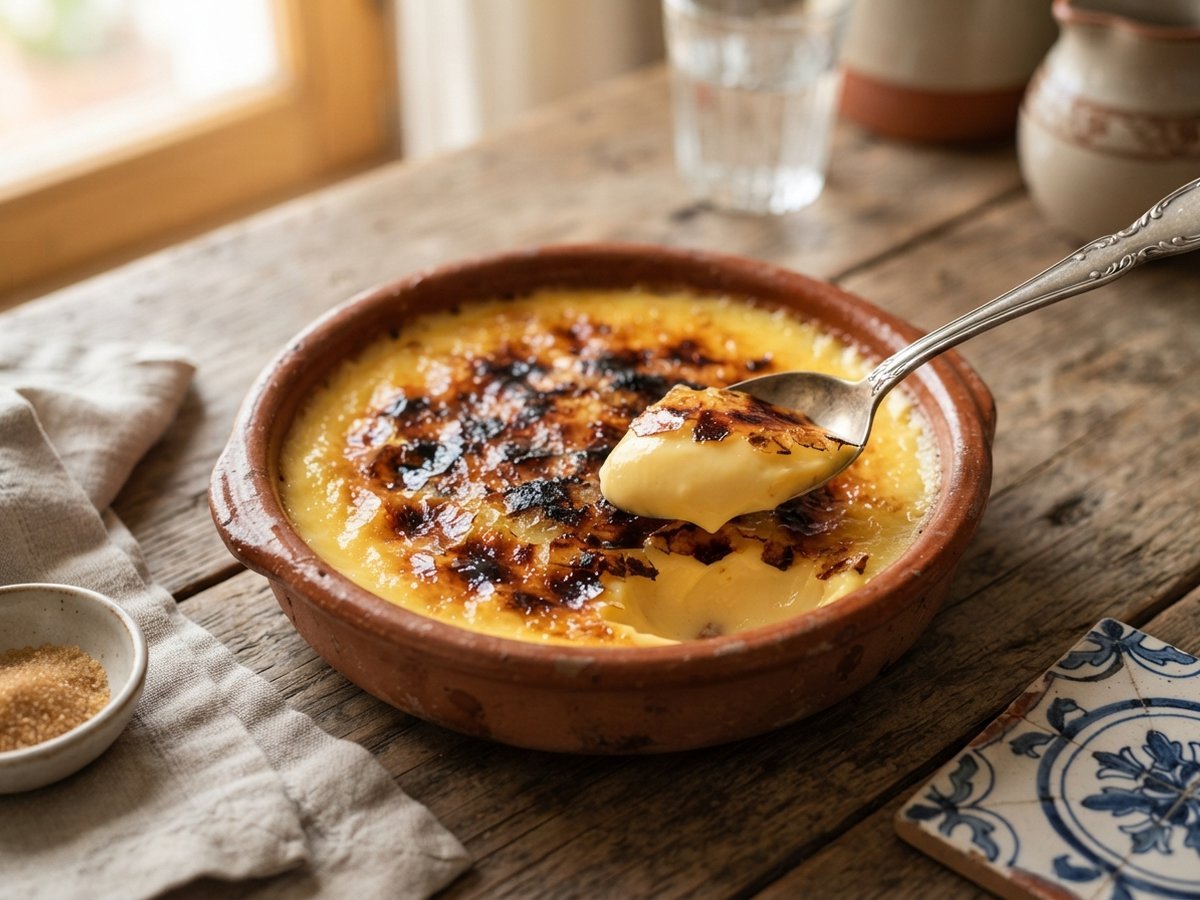
Leite-Creme (Portuguese Burnt Custard)
- Prep
- 10 min
- Total
- 25 min
- servings
- 8
- Calories
- 290 kcal
- Difficulty
- Easy
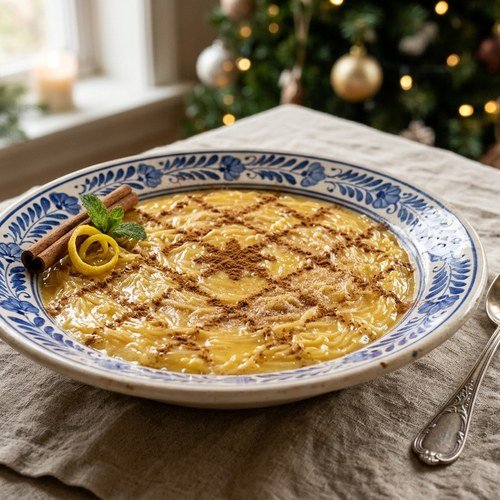
Leite-creme is one of the most universally loved Portuguese desserts, on Sunday lunch tables from north to south and on Christmas Eve next to arroz doce and aletria. Unlike French crème brûlée, made with cream and vanilla and baked in a bain-marie, real leite-creme is made with milk, lemon and cinnamon and thickened in the pan in minutes.
The best moment comes just before it reaches the table, when the hot iron or the torch touches the sugar and raises a fragrant puff of caramel smoke, leaving a crust of glass that breaks at the touch of a spoon.
Recipe
Leite-Creme Queimado Tradicional
The great classic of Portuguese Sunday lunches and Christmas Eve: a silky custard of whole milk, egg yolks, lemon peel and cinnamon (thickened in the pan, never baked), covered at the last minute with a thin, crisp layer of burnt sugar.
Ingredients
For the custard
For burning at serving time
Method
Infusing the milk and mixing the yolks
- 1Set aside 150 ml of the liter of cold milk. Bring the other 850 ml to the boil in a medium pan with the lemon peel, cinnamon sticks and pinch of salt. Turn off the heat, cover and let it infuse for 10 minutes so the milk takes on the scent of the lemon and cinnamon.
- 2Meanwhile, in a wide bowl, dissolve the cornstarch in the 150 ml of cold milk you set aside, whisking until there are no lumps at all. Add the sugar and the 8 yolks and whisk just until smooth.
Thickening over low heat without curdling
- 3Remove the lemon peel and cinnamon sticks from the warm milk. Pour half the warm milk slowly over the yolk mixture, whisking all the time to temper the eggs.
- 4Pour everything back into the pan and cook over medium-low heat, stirring continuously in a figure of eight across the bottom with a wooden spoon or spatula for 6 to 8 minutes.
- 5As soon as the custard thickens and gives its first slow bubble (about 82 to 85 °C), keep stirring for 1 minute to cook the starch and take it off the heat at once.
- 6Pour into a glazed clay dish or individual terracotta bowls and let it cool completely (at least 2 hours) until a dry skin forms on top.
Burning the sugar until crisp
- 7Just 10 to 15 minutes before serving, sprinkle the well-chilled custard with an even layer of brown (or white) sugar and burn it with a red-hot iron or a kitchen torch until it forms a crisp amber glass.
Tips
Always dissolve the cornstarch in cold milk first: added to hot milk or straight to the yolks, it forms lumps you can’t get rid of.
About 45 g of cornstarch per liter of milk is the right measure: less, and it’s too runny; much more, and it sets like a flan.
Wait until the custard is completely cold before burning it: on warm custard the sugar melts into the moisture and won’t caramelize. Without an iron or a torch, heat the back of an old steel spoon in a gas flame, or pour a thin stream of dry caramel over the top.
The custard can be made the day before and kept covered in the fridge; burn it at the last minute.