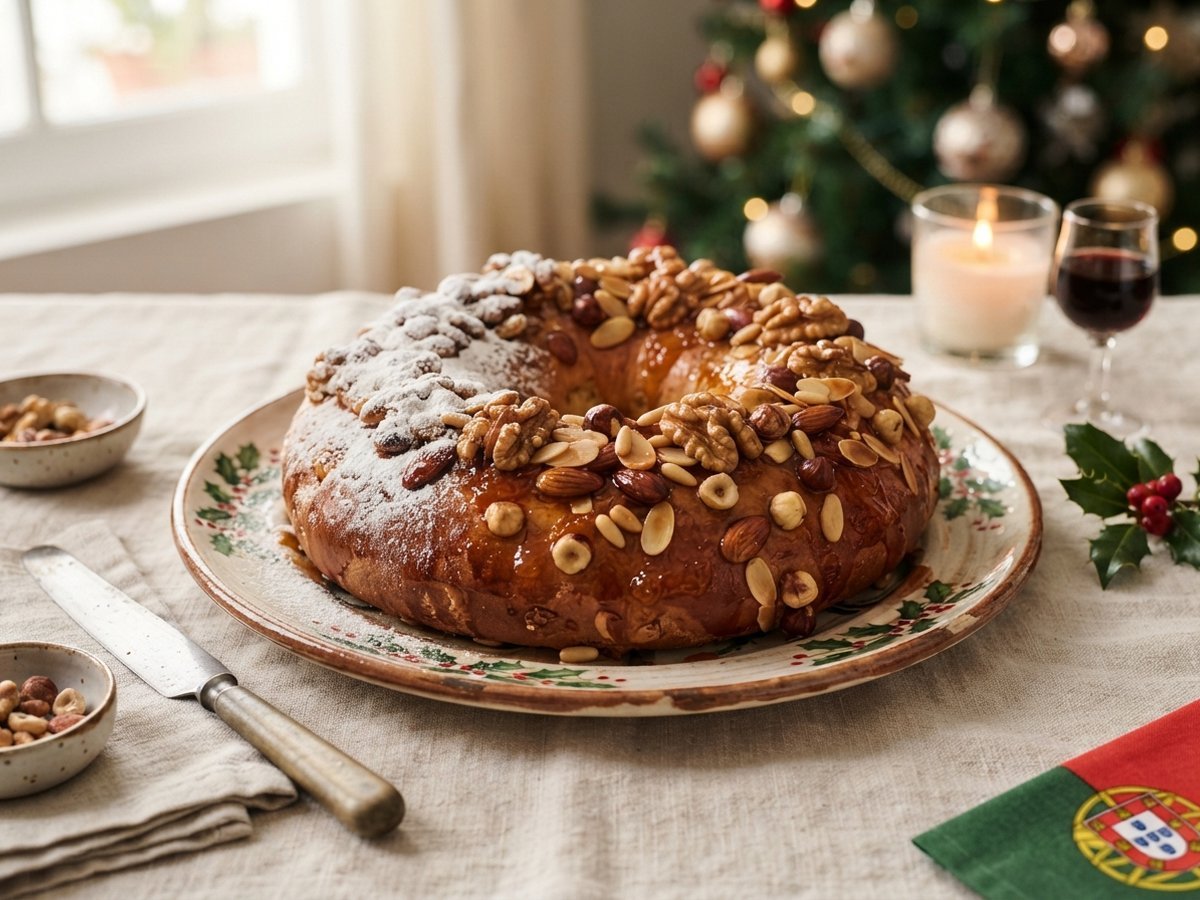
Bolo-Rainha (Portuguese Christmas Queen Cake with Nuts)
- Prep
- 40 min
- Total
- 3 h 35 min
- slices
- 12
- Calories
- 365 kcal
- Difficulty
- Medium
Bolo-rainha (“queen cake”) was born in Portuguese pastry shops as the answer for half of every family at the Christmas table: those who love the soft, moist, port-scented brioche of bolo-rei but always pushed the candied fruit to the side of the plate.
In bolo-rainha the candied fruit gives way to a generous crown of walnuts, almonds, toasted hazelnuts, Portuguese pine nuts and port-soaked raisins. Today it’s as popular as bolo-rei itself, from early December to Epiphany (January 6).
Recipe
Bolo-Rainha Tradicional
For everyone who loves the rich, soft, port-scented dough of bolo-rei but would rather skip the candied fruit: bolo-rainha has a generous mix of walnuts, almonds, hazelnuts, pine nuts and raisins soaked in port.
Ingredients
For the yeast sponge
For the enriched dough
For the nut filling and topping
Method
Soaking the nuts and starting the sponge
- 1In a bowl, put the raisins and the chopped nuts (keeping back some walnut halves, almonds and pine nuts for decoration) with the port and brandy. Leave to soak for at least 30 minutes.
- 2In another bowl, dissolve the yeast and 1 teaspoon of sugar in the 90 ml of warm milk, add the 100 g of sponge flour, mix to a soft ball, cover and let it rise for 25 minutes until doubled.
Kneading and the first rise
- 3In the bowl of a stand mixer (or on a wide counter), put the 400 g of flour, the sugar, the salt and the orange and lemon zest. Add the risen sponge and the 3 beaten eggs and knead for 5 minutes.
- 4Add the soft butter a little at a time, kneading for another 8 to 10 minutes until the dough is elastic, glossy and comes away from your hands.
- 5Drain the soaked nuts (adding the port to the dough if it's firm) and work them into the dough. Shape into a ball, cover with a damp cloth and let it rise somewhere warm for 1 hour 30 minutes, until doubled.
Shaping the crown, rising and baking
- 6Move the dough to a tray lined with parchment paper, shape it into a ball and open a wide hole in the middle with your fingers (about 10 to 12 cm across, so it doesn't close in the oven), putting a small greased bowl in the center if you want to keep the shape.
- 7Cover again and let it rise a second time for 45 minutes.
- 8Preheat the oven to 180 °C (350 °F). Brush the cake with the beaten yolk, decorate the top with the reserved walnut halves, almonds, hazelnuts and pine nuts, and add 3 or 4 little heaps of powdered sugar moistened with drops of water.
- 9Bake for 30 to 35 minutes until golden (if it browns too fast at 20 minutes, cover loosely with foil). Take it out, brush it while hot with thinned quince or apricot jelly to make it shine and let it cool on a rack.
Tips
Always make the sponge first: it gives the yeast the strength to lift a dough loaded with butter, eggs and nuts.
Add the butter only after kneading the flour and eggs for 5 minutes; added at the start, the fat slows down the gluten.
Toast the hazelnuts and almonds for the inside for 3 minutes in a dry pan before soaking them. The dough is naturally sticky before rising: oil your hands rather than adding more flour, which makes it dry.
You can let the dough rise overnight in the fridge after the first kneading, then shape it, let it rise for 1 hour at room temperature and bake. It keeps wrapped for up to 4 days and freezes well in slices.